Choosing a Dental Lab for Dentures and Partial Dentures: A Dentist's Guide


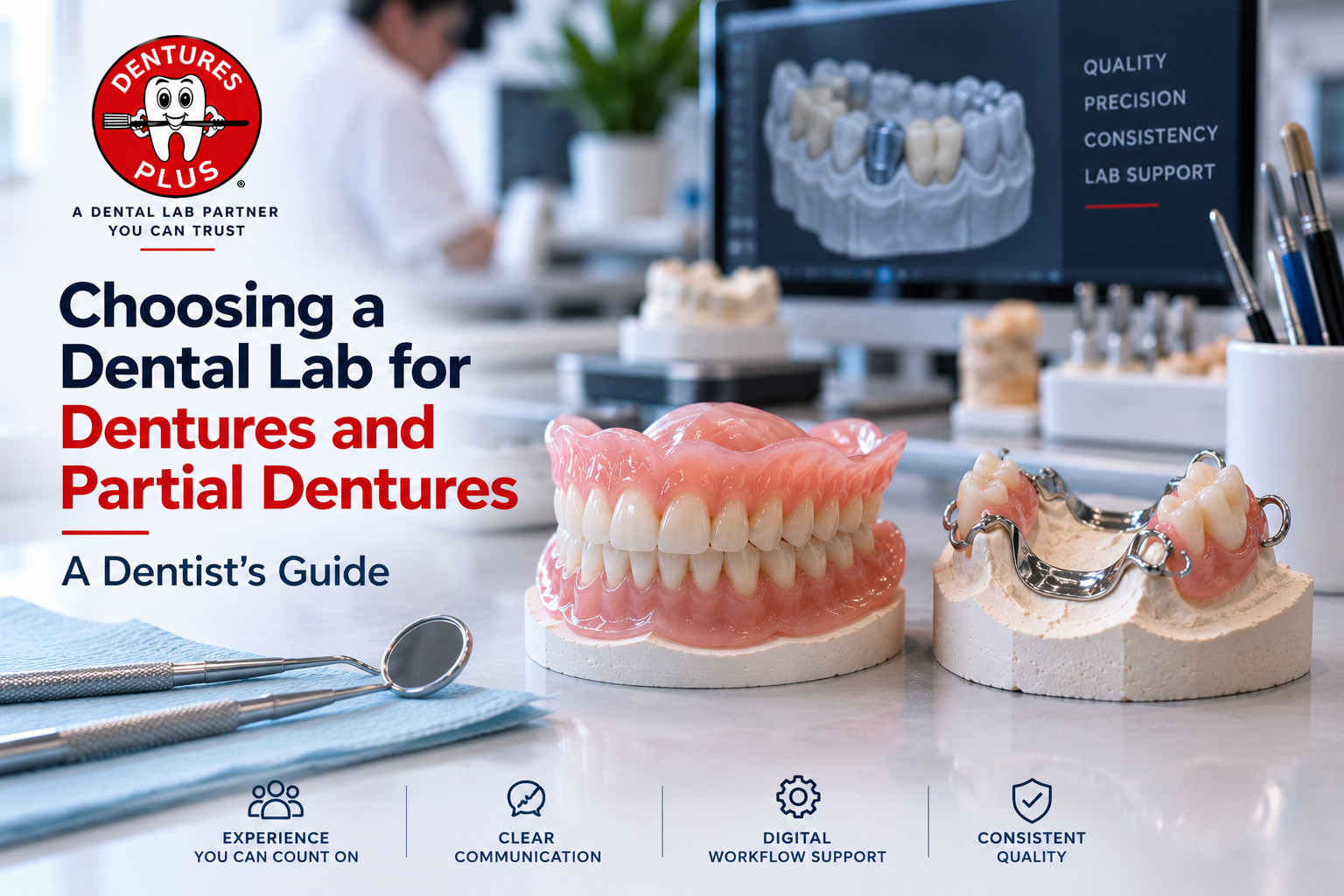
For dental practices, choosing the right dental laboratory for dentures and partial dentures is about more than simply finding a laboratory that can produce the restoration.
Dentists also need to consider communication, case handling, digital capabilities, consistency, turnaround expectations, and the laboratory's ability to understand the specific requirements of each case.
A strong dental lab partnership can become an important part of a practice's restorative workflow.
Here are some practical factors dentists should consider when choosing a dental laboratory for dentures and partial dentures.
1. Look at the Laboratory's Experience
Dentures and partial dentures can involve different designs, materials, clinical requirements, and patient-specific considerations.
A laboratory should have experience working with the types of cases regularly submitted by the dental practice.
For dentists, it can be useful to ask:
• What types of dentures does the laboratory provide?
• Does the lab handle both full and partial dentures?
• Can it support different case requirements?
• Does the laboratory have experience with complex restorative cases?
The goal is to find a laboratory that understands the type of work your practice regularly performs.
2. Communication Should Be Easy
Clear communication is one of the most important parts of a dentist-laboratory relationship.
A denture or partial denture case may require specific instructions regarding design, shade, tooth arrangement, bite records, photographs, or other case details.
If something is unclear, the laboratory should have a straightforward way to communicate with the dental practice.
Likewise, dentists should be able to provide additional instructions or clarification when necessary.
A laboratory that communicates clearly can make case management easier for the entire dental team.
3. Case Information Matters
The laboratory can only work with the information provided with the case.
Depending on the denture or partial denture, the laboratory may need:
• Impressions or digital scans
• Bite and occlusal records
• Shade information
• Photographs
• Tooth selection or design preferences
• Case-specific instructions
• Existing denture information when relevant
Providing complete and accurate information gives the laboratory a better understanding of what the dentist expects.
4. Digital Capabilities Can Add Flexibility
Digital dentistry has also become part of modern denture workflows.
Depending on the case and laboratory capabilities, dentists may be able to submit digital scans and STL files rather than relying entirely on traditional impressions.
Digital workflows can make case communication more convenient and help connect the dental practice with laboratory production.
However, digital technology should complement—not replace—clear case instructions and professional communication.
Dentists should therefore look for a laboratory that can work with the digital workflow used by their practice.
5. Consider the Laboratory's Range of Services
A dental practice may need more than dentures and partial dentures.
The same practice may regularly send cases involving crowns, bridges, implant restorations, veneers, dental appliances, or other laboratory services.
Working with a full-service laboratory can make it easier for a dental practice to maintain a consistent laboratory relationship across different types of cases.
It also gives the dental team a familiar laboratory partner when a more complex case requires additional support.
6. Quality and Consistency Matter
Dentists need laboratory work that is consistent from case to case.
Consistency involves more than the appearance of the finished restoration. It also includes the laboratory's approach to case handling, communication, documentation, and quality control.
When a dental practice works with the same laboratory regularly, consistent processes can also make it easier for the laboratory team to understand the dentist's preferences over time.
7. Understand the Laboratory Workflow
Before choosing a laboratory, dentists can ask how the lab manages cases from submission through completion.
Questions might include:
• How are cases submitted?
• Does the lab accept digital scans?
• How are special instructions communicated?
• How are cases reviewed?
• How does the lab communicate when clarification is needed?
• What happens if a case requires additional information?
Understanding the workflow beforehand can help a dental practice know what to expect.
8. Look for Professional Support
A dental laboratory should be more than a place where a case is sent and a restoration is returned.
For many practices, having a laboratory partner that understands their workflow can make case management more straightforward.
Professional support may include:
• Case communication
• Digital workflow support
• Technical discussion
• Case-specific guidance
• Coordination on complex cases
• Consistent laboratory service
The exact level of support varies between laboratories, so dentists should choose a workflow that fits their practice.
9. Consider the Needs of Your Practice
There is no single laboratory workflow that is right for every dental practice.
A practice that primarily handles removable prosthetics may have different requirements from a practice that focuses heavily on implant restorations or digital restorative dentistry.
Before selecting a laboratory, dentists should consider:
• Types of cases they submit most often
• Digital systems used by the practice
• Communication preferences
• Expected case volume
• Range of laboratory services needed
• Case complexity
• Geographic considerations
Choosing a laboratory based on the actual needs of the practice can create a more practical long-term relationship.
10. Dentures Plus as a Dental Laboratory Partner
Dentures Plus works with dentists and dental clinics to provide professional dental laboratory services, including dentures and partial dentures.
Our laboratory services also include crowns and bridges, implant restorations, veneers, dental appliances, and other restorative solutions.
We support digital workflows, including major intraoral scans and STL files, while maintaining a focus on laboratory craftsmanship and communication with dental professionals.
For dental practices, the goal is to have a laboratory partner that can support their workflow across different types of cases.
Questions Dentists Can Ask Before Choosing a Dental Lab
Before starting a relationship with a new laboratory, dentists may want to ask:
Does the lab handle the types of denture cases my practice regularly sends?
Can the lab accept my digital scans or STL files?
How does the lab communicate about case questions?
What other laboratory services are available?
How are special case instructions handled?
Can the lab support more complex cases when needed?
These questions can help a dental practice understand whether the laboratory's workflow matches its own.
Building a Long-Term Dentist-Lab Relationship
Choosing a dental laboratory is not necessarily a one-time decision.
As a practice and laboratory work together, both teams can become more familiar with each other's workflows, communication preferences, and case requirements.
That familiarity can be valuable when managing regular denture and partial denture cases.
A strong relationship is built through consistent communication, reliable case handling, and a shared understanding of professional expectations.
Final Thoughts
Choosing a dental laboratory for dentures and partial dentures involves more than comparing individual restorations.
Dentists should consider the laboratory's experience, communication, digital capabilities, range of services, consistency, and ability to support the practice's workflow.
The right laboratory relationship should make case communication clear and laboratory collaboration easier to manage.
For dentists, a dental laboratory should be more than a service provider—it should be a dependable part of the restorative workflow.