
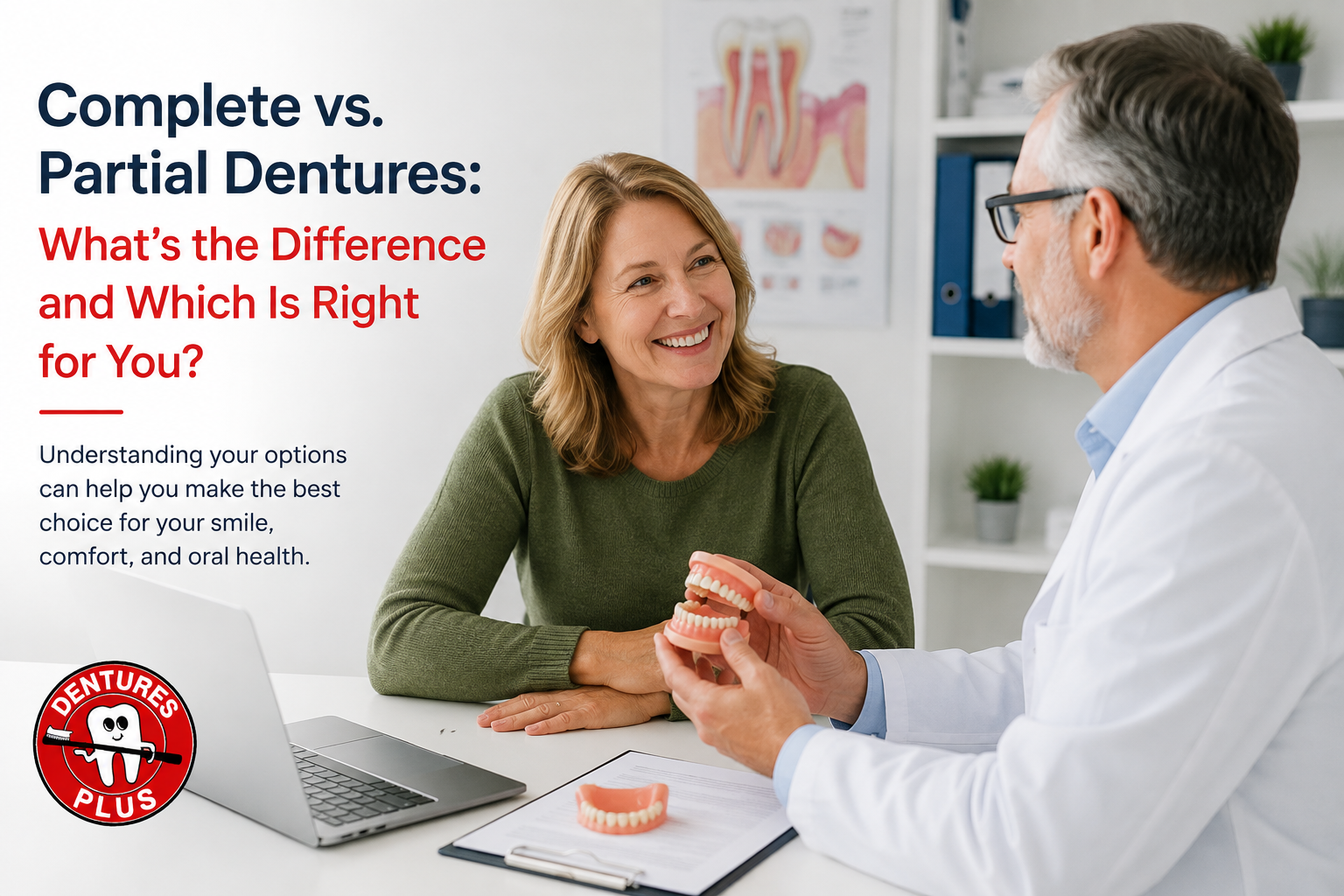
Missing teeth can affect much more than your smile. They can make eating harder, change the way you speak, and affect your confidence in everyday situations. Fortunately, dentures can replace missing teeth and help restore both function and appearance.
But not every denture is designed for the same situation.
If you are missing all of the teeth in one arch, complete dentures may be an option. If you still have some healthy natural teeth, a partial denture may be more appropriate.
So, what is the difference between complete and partial dentures, and how do you know which type is right for you?
Complete dentures, sometimes called full dentures, are removable dental appliances designed to replace an entire set of missing teeth in the upper arch, lower arch, or both.
They typically include artificial teeth attached to a gum-colored base. The base is designed to sit over the gums and provide support for the replacement teeth.
Complete dentures may be considered when a patient has lost all natural teeth in an arch or when the remaining teeth cannot be restored predictably.
A properly designed complete denture can help with:
The fit is particularly important. Dentures that do not fit properly can move while eating or speaking and may cause sore areas or irritation.
Partial dentures are designed for people who are missing some teeth but still have natural teeth remaining.
Unlike complete dentures, partial dentures fill selected gaps rather than replacing every tooth in an arch. Depending on the design, they may use the remaining natural teeth for support and stability.
Partial dentures can be made in different designs and materials depending on the patient's needs, the location of the missing teeth, and the teeth available to support the appliance.
A partial denture can help:
The exact design should be determined after an appropriate dental evaluation.
The simplest way to understand the difference is this:
Complete dentures replace all teeth in an arch, while partial dentures replace some missing teeth when natural teeth remain.
| Feature | Complete Dentures | Partial Dentures |
|---|---|---|
| Teeth replaced | All teeth in an arch | Some missing teeth |
| Natural teeth remaining | Usually none in that arch | Some natural teeth remain |
| Main purpose | Replace a full arch of teeth | Fill specific gaps |
| Support | Gums and underlying structures | Natural teeth and oral tissues, depending on design |
| Design | Full arch | Customized around remaining teeth |
The right option depends on the condition of your mouth rather than simply the number of teeth missing.
The answer depends on several factors.
If all teeth in an upper or lower arch are missing, a complete denture may be considered.
If several natural teeth remain, a partial denture may provide a way to replace the missing teeth while working around the teeth that are still present.
Having natural teeth does not automatically mean that a partial denture is the best choice.
Your dentist may need to evaluate the health, position, stability, and strength of the remaining teeth before determining how they can be used to support a removable appliance.
A denture needs to fit the individual shape of the patient's mouth.
Changes in the gums and underlying bone can occur over time, which can affect how a previously comfortable denture fits. The American Dental Association notes that poorly fitting dentures may need professional adjustment, relining, or replacement rather than simply relying on adhesive.
Someone who needs to replace a few missing teeth may have different priorities from someone who has lost an entire arch.
Your dentist can consider factors such as chewing needs, appearance, speech, comfort, remaining teeth, and overall oral health when discussing treatment options.
Neither option is automatically "better."
They solve different problems.
A partial denture is intended for a mouth where some natural teeth remain. A complete denture is intended to replace an entire arch of missing teeth.
The better choice is the one that matches the patient's individual dental situation and provides an appropriate combination of function, fit, appearance, and comfort.
This is why choosing a denture should not be based only on price or appearance.
Comfort is closely connected to proper fit and design.
A well-made denture should be designed around the patient's individual oral anatomy. The artificial teeth, base, and supporting areas all need to work together.
A denture that is too loose may move during normal activities. One that puts excessive pressure on certain areas can create discomfort.
If you experience persistent soreness, slipping, clicking, difficulty eating, or a sudden change in the way your denture fits, it is worth having the denture evaluated.
The American Dental Association identifies poor fit, persistent irritation, cracks, fractures, discoloration, and other changes as reasons a removable denture may need professional evaluation.
There is no single lifespan that applies to every denture.
How long a denture remains useful depends on factors such as:
Even when a denture still looks acceptable, changes in the mouth can eventually affect its fit.
The American College of Prosthodontists, as referenced by the American Dental Association, recommends professional evaluation for replacement when certain problems occur and notes five years as an important point for evaluation.
That does not mean every denture automatically needs to be replaced after five years. It means the denture and the patient's oral condition should be evaluated rather than relying on age alone.
Sometimes, yes.
If the denture itself is still in good condition but the mouth has changed, a dental professional may determine that an adjustment or reline could improve the fit.
However, relining or adjustment is not appropriate for every situation. A denture that is badly worn, cracked, broken, significantly discolored, or otherwise no longer suitable may require replacement.
The important point is to identify the reason the denture no longer feels right before deciding what to do next.
Both complete and partial dentures require regular care.
A basic routine includes:
The ADA recommends daily denture cleaning and advises against using hot or boiling water because it can cause dentures to warp.
Partial denture wearers should also pay particular attention to cleaning the natural teeth that remain because those teeth can continue to develop oral health problems.
Consider arranging an evaluation if your dentures:
You should not have to simply tolerate an uncomfortable denture.
A professional evaluation can help determine whether the problem is related to fit, wear, damage, changes in the mouth, or the need for a new restoration.
The difference between complete and partial dentures is straightforward: complete dentures replace all teeth in an arch, while partial dentures replace some missing teeth when natural teeth remain.
But choosing the right denture is more than deciding between two types.
The condition of your remaining teeth, the shape and health of your mouth, the number of missing teeth, your functional needs, and the fit of the restoration all matter.
A properly designed and fitted denture can make everyday activities such as eating, speaking, and smiling feel more natural again.
At Dentures Plus, we work with dental clinics to support the creation of customized dental restorations designed around each patient's individual needs. If you are considering complete or partial dentures, speak with your dental professional about which option is appropriate for your situation.
A better-fitting denture starts with the right design and the right evaluation.