How Dental Labs Support Complex Full-Mouth Reconstruction Cases


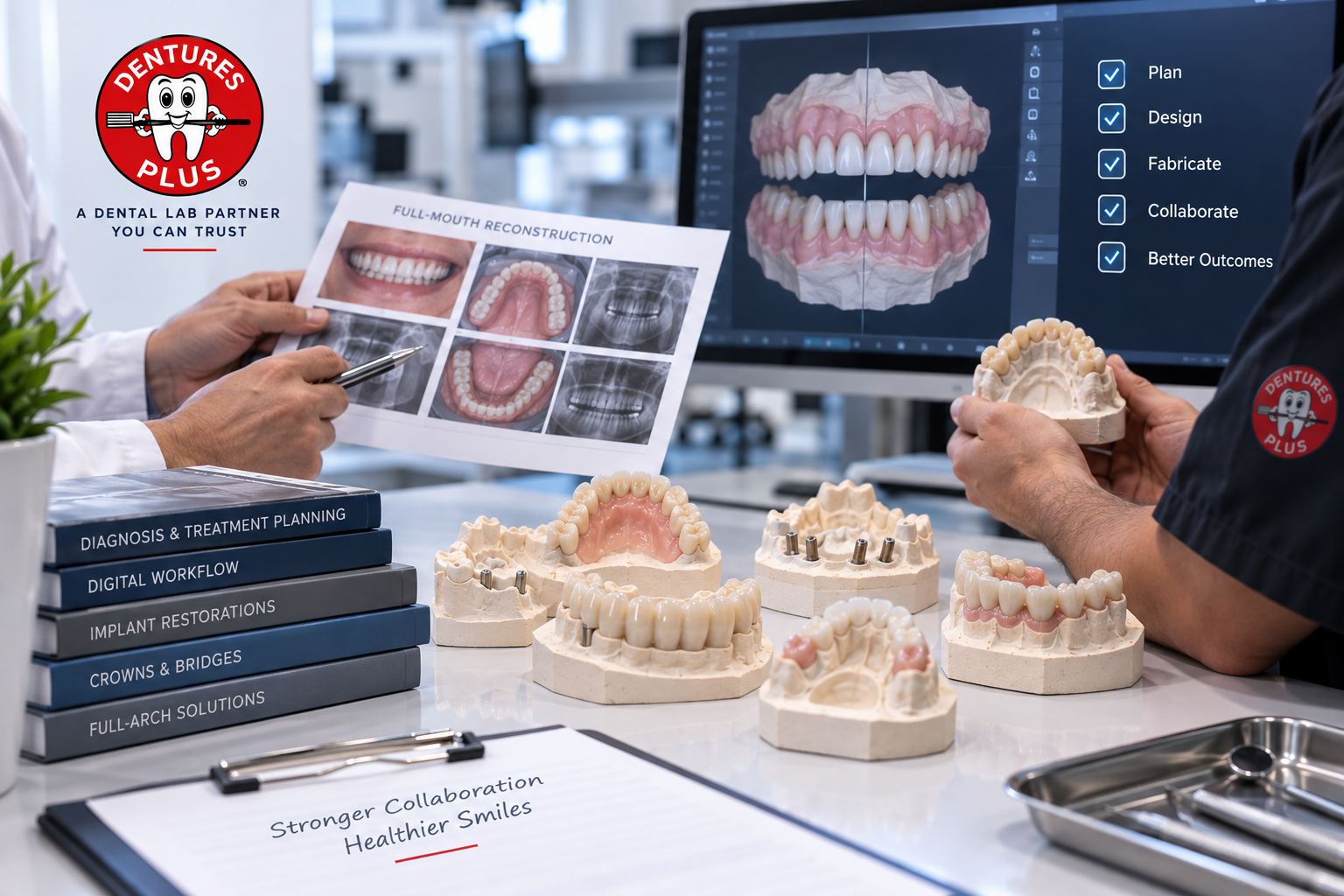
Full-mouth reconstruction cases can involve multiple teeth, different types of restorations, and several stages of treatment. For the dentist, managing these cases requires careful clinical planning. For the dental laboratory, it requires equally careful communication, organization, and attention to the details of each restoration.
Because multiple restorations may need to work together, the dental laboratory becomes an important part of the overall workflow.
From case planning and digital records to individual restoration design and final laboratory production, communication between the dental practice and laboratory can make a significant difference in how a complex case is managed.
What Is Full-Mouth Reconstruction?
Full-mouth reconstruction generally involves restoring or rebuilding multiple teeth throughout the mouth.
Depending on the patient's clinical needs, a case may involve several types of restorative work, such as:
• Crowns
• Bridges
• Implant restorations
• Veneers
• Dentures or partial dentures
• Other dental appliances
The exact combination varies from case to case.
Because multiple restorations may be involved, coordination becomes particularly important. The dentist and laboratory need to understand how the different components of the case relate to one another.
Why the Dental Laboratory Matters in Complex Cases
In a simple case, a laboratory may receive a prescription for a single restoration.
A full-mouth reconstruction can be much more involved.
The laboratory may need to manage multiple restorations while considering the information provided by the dentist about the overall case.
This can include:
• Digital scans or impressions
• Bite and occlusal records
• Photographs
• Shade information
• Tooth preparation information
• Restoration specifications
• Implant-related information
• Specific esthetic or functional instructions
A laboratory that understands the broader case can better organize the information needed for the individual restorations.
1. Start With Complete Case Information
Complex cases require more than a basic prescription.
Before laboratory work begins, dentists should provide the records and instructions appropriate for the case.
Depending on the treatment plan, this may include digital scans, traditional impressions, photographs, bite records, shade information and detailed case instructions.
The laboratory should also know which restorations are being requested and how the different parts of the case are expected to work together.
Clear information at the beginning gives the laboratory a better foundation for the rest of the workflow.
2. Digital Scans Can Help Connect the Practice and Lab
Digital dentistry has become an important part of modern laboratory workflows.
For practices using intraoral scanners, digital files can be transferred to a compatible dental laboratory rather than relying entirely on physical impressions.
STL files and other digital case information can become part of the laboratory's design and production process.
For complex cases, digital records can also provide useful information about the overall case and help connect different stages of laboratory work.
However, the digital scan should still be accompanied by the appropriate prescription and case instructions.
3. Occlusion and Bite Records Are Important
When multiple restorations are being planned, understanding the relationship between the upper and lower arches is an important part of the laboratory workflow.
Dentists should provide the appropriate bite and occlusal records required for the case.
The laboratory can then use the submitted information when working on applicable restorations.
Because every full-mouth reconstruction is different, the specific records required will depend on the clinical situation and treatment plan.
4. Esthetic Communication Becomes More Important
Full-mouth cases can involve multiple visible restorations, making esthetic communication an important consideration.
The dentist may have specific preferences regarding:
• Tooth shape
• Shade
• Contours
• Characterization
• Overall appearance
• Relationship between different restorations
Photographs can sometimes provide useful additional information when written instructions alone do not fully communicate the desired result.
Clear communication gives the laboratory a better understanding of the dentist's expectations.
5. Multiple Restorations Require Coordination
One of the biggest differences between a single-unit restoration and a complex full-mouth case is coordination.
Several restorations may need to be designed and produced as part of the same overall treatment plan.
The laboratory therefore needs to keep track of the different components of the case and the instructions associated with each one.
Consistent communication between the dentist and laboratory can help keep the different parts of the case organized.
6. Communication Should Continue Throughout the Case
Communication should not stop once the case has been submitted.
Complex cases can raise questions during the laboratory process.
If additional information is required, the laboratory should have a clear way to communicate with the dental practice.
Likewise, if the dentist needs to communicate a change or additional instruction, the laboratory should be able to incorporate that information into the appropriate stage of the workflow.
This ongoing communication is especially valuable when multiple restorations are involved.
7. Temporary and Final Restorations May Require Different Considerations
Some complex restorative cases involve multiple stages.
Depending on the treatment plan, temporary and final restorations may have different laboratory requirements.
The dentist should clearly communicate which stage of the case is being submitted and what the laboratory is expected to produce.
Keeping the laboratory informed about the stage of treatment can help prevent confusion when several related cases or restorations are being managed.
8. Implant Restorations Can Add Another Layer of Complexity
When implants are part of a full-mouth reconstruction, additional laboratory information may be required.
The laboratory may need relevant implant specifications, digital information, components information and restoration instructions depending on the case.
Because implant restorations can be integrated with other restorations in a larger treatment plan, communication between the dentist and laboratory becomes particularly important.
The exact laboratory requirements will depend on the implant system, restoration and case workflow.
9. Choosing the Right Laboratory for Complex Cases
Not every dental laboratory handles complex cases in the same way.
Dentists considering a laboratory partner for full-mouth reconstruction cases can look at several practical factors.
Experience With Multiple Restoration Types
Does the laboratory have experience with the different types of restorations your case may require?
Digital Capabilities
Can the laboratory receive and work with the digital files used by your practice?
Communication
Is there a clear process for discussing complex cases and resolving questions?
Case Organization
Does the laboratory have an organized workflow for managing multiple restorations?
Range of Services
Can the laboratory support different parts of the treatment plan when needed?
These factors can help dentists determine whether a laboratory is suited to the needs of their practice.
10. How Dentures Plus Supports Complex Laboratory Cases
Dentures Plus is a full-service dental laboratory serving dentists and dental clinics with a range of restorative and laboratory solutions.
Our services include crowns and bridges, implant restorations, dentures and partial dentures, veneers, dental appliances and other laboratory services.
We also support digital workflows, including major intraoral scans and STL files.
For complex cases, the goal is to provide dental professionals with laboratory support that combines digital capabilities, experienced craftsmanship and clear communication.
A Strong Dentist-Lab Partnership Makes a Difference
A full-mouth reconstruction is not simply a collection of individual restorations.
The different parts of the case need to be considered within the overall treatment plan.
That is why communication between the dentist and laboratory is so important.
When the dental practice provides complete information and the laboratory maintains a clear, organized workflow, both sides have a better understanding of the case requirements.
The result is a more coordinated laboratory process.
Final Thoughts
Complex full-mouth reconstruction cases require careful planning and coordination between the dental practice and laboratory.
Accurate records, digital scans or impressions, bite information, photographs, shade details and clear prescriptions give the laboratory the information needed to understand the case.
Just as importantly, communication should continue throughout the laboratory process when questions or changes arise.
For dentists, choosing a laboratory partner for complex restorative cases is therefore about more than individual restorations. It is about finding a laboratory that can communicate clearly, manage complex workflows and support the practice throughout the case.
A well-coordinated dentist-laboratory relationship can make complex restorative workflows easier to manage from case submission through laboratory production.